

Building for Communities, Part 2: The Principles Behind Great Real Estate Development
Almost everyone gets into real estate development through a deal or a one-off project. You find a site, or a site finds you, and you learn what you need to know to get the job done.
But learning this way has a blind spot, even for experienced developers. You only learn what your deals happen to teach you. If a particular kind of risk, negotiation, or financing structure never comes up, you never learn that one — until one day that risk happens on a deal where the stakes are much higher than you’re prepared for, and when you have to solve the problem now.
What Development Actually Is
As the developer, you almost act as an orchestra director. You are keeping all the different instruments playing on the same sheet music. Even if they all sound differently and come at different paces, you are pointing, raising one, lowering another, making sure that everyone is on the same page. When you do that well, you can create a beautiful symphony.
Michael Green, an Atlanta-based developer
Developers are translators — moving among public officials, private capital, architects, contractors, and communities, each stakeholder speaking a different language and with different incentives, but all needing to end up playing the same piece of music.



How to Think About the Money
Every complex real estate deal is, in some sense, a puzzle of incomplete pieces.
“You stitch the pieces together,” says David Smith, a longtime instructor in Harvard GSD Executive Education’s real estate programs. “You know how much ground you have to cover. The market will cover this much. Another part of the market will cover that much. There are a bunch of holes. You stitch it together, and you go to the people who have money and want to see the whole thing come together.”
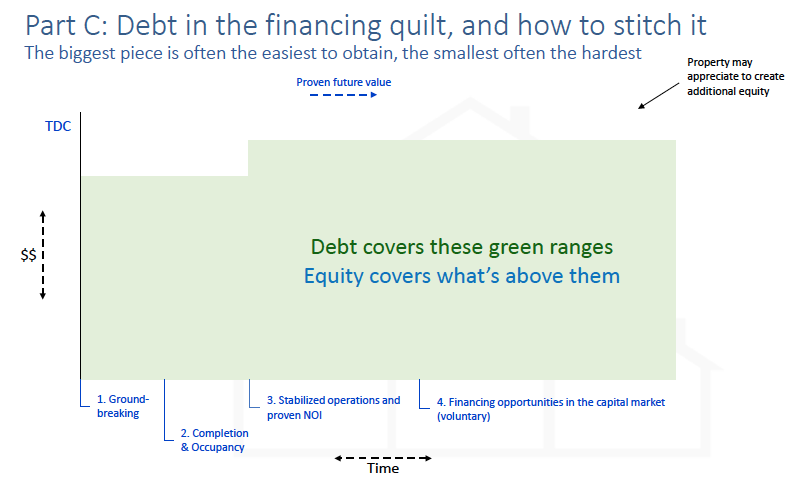
Smith calls this the financing quilt — and after decades of teaching developers how to build one, he’s distilled the underlying logic into four questions he asks about every capital structure, public or private. He sometimes calls them Count Dracula’s four questions:
- What do I put in?
- What do I get back?
- When and how do I get it back?
- What are you putting in alongside me?
Whether they realize it or not, every investor, lender, and public agency in a deal eventually confronts these four questions and decides if the developer’s answers are acceptable. A developer who can answer them clearly for every party at every stage can get a clear Yes, No, or Maybe-if. And a developer who can’t get clear answers can’t get to a viable closing.
Underneath those questions sits a related principle: risk allocation and risk mitigation.
“Every risk that exists, somebody is taking — whether they know it or not.”
David Smith
Deals become more viable when they reduce risk, and they can reduce aggregate risk by migrating individual risks to the parties best willing to spot, evaluate, and take each individual risk. The best developers are explicit about reward versus risk from the start, Smith says, rather than letting it get discovered later.
This approach can be summarized in David Smith’s own words: “You do it reasonably transparently, because the government’s got to know, the philanthropies have got to know. The stakeholders have got to know that this much input will get you this kind of output.” That approach builds trust with public agencies, philanthropic funders, and private partners alike.
How to Think About Stakeholders
Cities and public agencies often look for developers who think the way they do — cautious, process-driven, risk-averse. Smith argues that’s usually a mistake.
“Don’t look for a clone. Look for a complement,” he says. “You want somebody to take risks, and you want somebody to squeeze the nickels.”
Even within private development projects, the strongest teams often pair people with different strengths and incentives, provided those incentives are disclosed and pointed at the same outcome. A developer who thinks exactly like the public agency they’re working with adds very little. A developer who thinks differently — and says so clearly — adds the thing the public sector cannot supply on its own.
As cities become more involved in land use, taxation, and infrastructure decisions, government becomes an unavoidable partner in the economics of nearly every project. Through real estate taxes and job creation, municipalities gain economic benefits equal to somewhere between 15 and 25 percent of a property’s value, Smith has calculated, whether the municipality consciously realizes this or not.
Smith calls this convergent evolution. Developers who invest in educating the public sector on the land-use economics and development challenges they face can spot risks early on and reduce them for all parties. He argues this approach is practical. “It’s hard enough to make these deals work even with things going your way,” he says. “It’s always in your interest to head off trouble that might impact one of your counterparties.”
Where Developers Go Wrong
The most common failures in real estate development are rarely dramatic: they’re not fraud or even bad intentions.
“Not capturing the details, not writing them down, and not having a sidekick to track everything as it goes,” Smith says, describing where developers most often go wrong at scale.
Large projects are unique and unrepeatable, and their complexity hides in details that are easy to lose track of. One little detail can derail the whole endeavor.
How the Best Developers Keep Getting Better
There are two ways most people learn this business: on their own or from a mentor.
“Almost everybody in development is either self-taught or individually mentored,” Smith says. “Both methods are excellent, but both are limited. Either way, you might overlook something because it hasn’t come up in your experience — or didn’t come up in your mentor’s experience.”
You can gain more experience the hard way—by making mistakes you didn’t see coming—or an easier way—by gaining structured exposure to the things you didn’t know you didn’t know.
“You want to catalog your experience, find the empty spots on your shelves of knowledge, and learn what you didn’t know you needed to know,” Smith says.
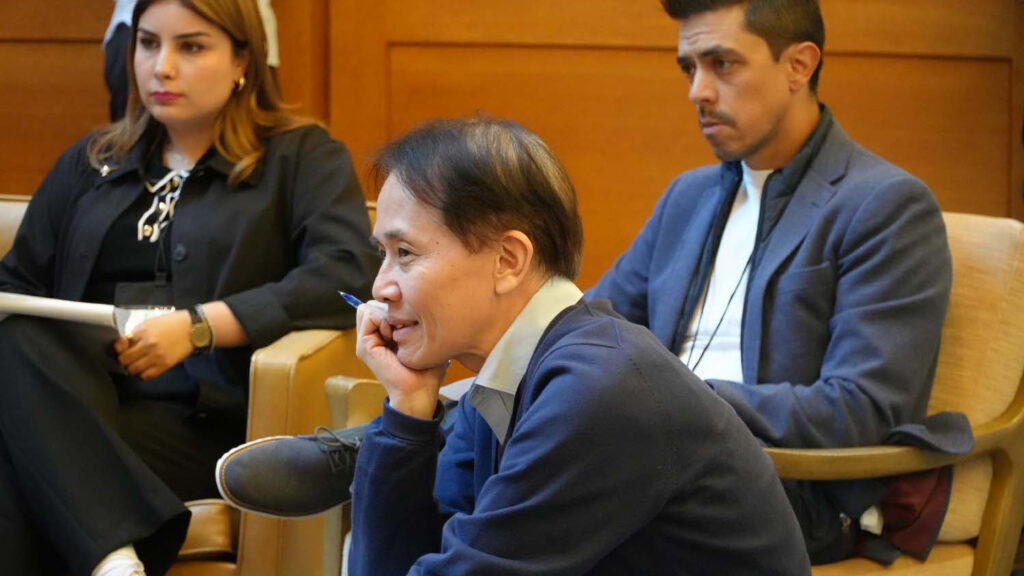
Peer learning compounds this. Other developers’ war stories from different markets, different asset types, different cycles, carry useful lessons precisely because they’re low-risk to hear. They happened in the past, somewhere else, to someone else. “There’s a huge value in swapping stories that way,” Smith says. “Something in your past can help someone else with their present problem. You come away with peers you can call the next time you hit something you haven’t seen before.”
The Foundation Everything Else Is Built On
The key principles of real estate development laid out here (reading a site, structuring a capital stack, choosing the right partners, avoiding the unglamorous mistakes that sink good projects) depend on a solid foundation in the fundamentals of real estate development and finance.
This is what David Smith teaches in Real Estate Development and Real Estate Finance, offered online and on campus.
For developers who’ve built that foundation and want to pressure-test it at the highest level of complexity, that is the territory of the Advanced Management Development Program in Real Estate (AMDP). Part 3 of this series tells the story of one developer who has spent decades working at exactly that level.
Real Estate Development 101: Focusing on the Basics
October 29, 30, November 3 & 4, 2026 | Online
11:00 am–01:00 pm Eastern
Real Estate Development Fundamentals
June 9-10, 2026 | On Campus
09:00 am–05:00 pm Eastern
Real Estate Finance 101: Focusing on the Basics
November 13, 16, 17, & 18, 2026 | Online
11:00 am – 01:00 pm Eastern
Real Estate Finance Fundamentals
June 11-12, 2026 | On Campus
09:00 am–05:00 pm Eastern
David Smith is an instructor in Harvard GSD Executive Education’s real estate programs. This piece is the second in Building for Communities, a three-part series. Read Part 1: The Case for Affordable Housing as Civic Infrastructure and Part 3: From Developer to Civic Builder — The Decade-long Journey to Reinvent the Atlanta Civic Center.