

Why the Best Real Estate Leaders Must Be Great Storytellers
Most real estate executives don’t think of themselves as storytellers, but the best real estate leaders are drawing from the same toolbox as any screenwriter or marketer. Building transformational projects requires telling a story, selling a vision, and sustaining both through the full lifecycle. We spoke to three people who operate at the intersection of storytelling and real estate and who now teach, advise, and learn from each other inside the same program for executives.
- Steve Tatham spent decades designing worlds for Disney and Universal and now advises on entertainment and experiential design.
- Carmine Gallo has spent his career researching, writing about, and coaching persuasive executives at many of the world’s best-known companies.
- Kristin Egan spent years developing major real estate projects, including the redevelopment of Rockefeller Center’s public realm, before becoming a full-time storyteller as the head of her own media company.
Our conversations with these individuals led to a framework that maps almost exactly how a real estate project comes to life. Every project starts with an idea that must be told well enough to survive contact with reality. The project then has to be sold to the people who control the money, the permits, and the land. And, once the deal is done and the building is standing, the story must be sustained, for years, by everyone who lives with what’s been built.
This is a walk-through of all three stages of real estate storytelling.
Telling: Finding the Story Before You Design
Steve Tatham has helped build some of the most immersive places on Earth. He was involved in nearly every Disney park built before Shanghai, Universal Studios Japan, and most recently, Universal’s Epic Universe in Orlando, where he served as Executive Creative Director. Today, as Chief Creative Officer at MDSX, he brings that same thinking to a much wider range of projects. One of his key insights into how projects outside themed entertainment are built came from his time in our Advanced Management Development Program in Real Estate (AMDP), where he was a member of Class 23.
“I noticed that the real estate developers in the program had tremendous projects — a real diversity of ideas,” Tatham says. “But when they pitched those projects, they were doing it entirely from a financial perspective. Everything was about the ROI, the math that makes a project work. I understand why — the numbers have to work. But it sounded like a math equation: if you have the right numbers, the formula comes together.”
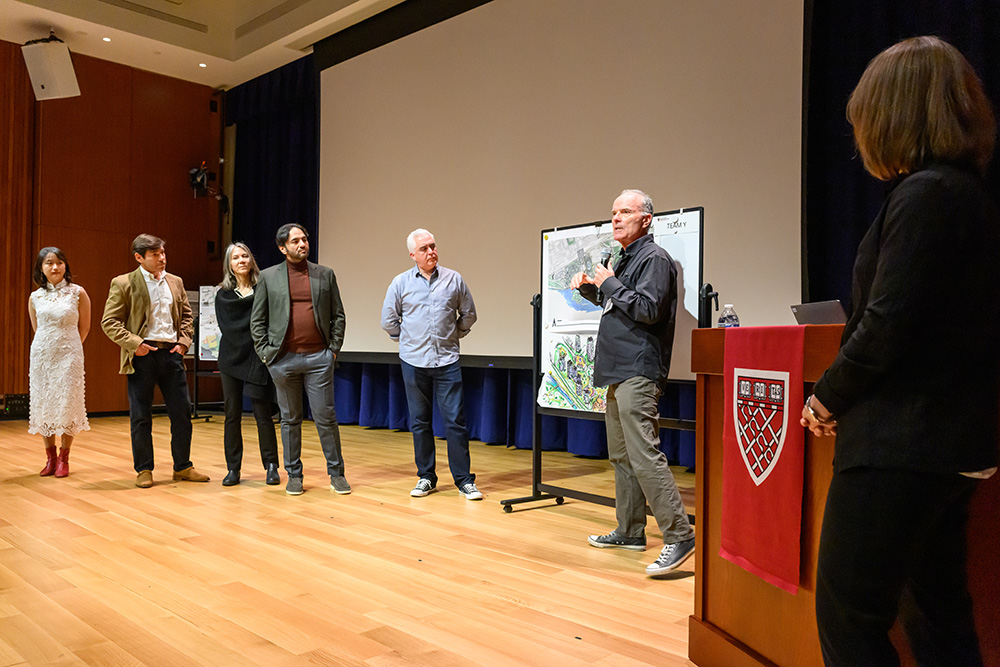
He felt that his fellow participants were missing something simple: the pitch was being made to human beings, and human beings respond to emotion before they respond to numbers.
“If you’re building housing, people are going to spend their lives there,” he says. “If you’re building a hospital, people begin and end their lives in that space. These are places where enormous, emotional stories take place, and I felt like these projects weren’t being done justice, because they weren’t being told in a way people could connect to emotionally.”
Form Follows Fiction
Architecture school, Tatham says, never taught him to think this way directly. What shaped his thinking, instead, was a career spent in an industry where everyone insists they are a storyteller, even when what they really mean is something narrower.
“A lot of times in themed entertainment, what people mean by storyteller is, ‘I’m using an intellectual property, I’m using the fonts and colors and characters from this IP,'” he says. “What I think it really means is something closer to what shows up in the history of architecture: that built environments evoke story.”
He points to the architect Ole Scheeren, who has described the idea as “form follows fiction” — a twist on “form follows function.” The idea, Tatham explains, is to imagine the stories of the people who will use a space and let that shape the design decisions that follow.
It’s a principle that applies at any scale, down to something as small as a chair.
“Every design decision evokes an emotion,” Tatham says. “I’ll often end a talk by showing two pictures of chairs and asking: Does it really not matter to you which one we use? Before I show the chairs, people might not understand — but when you show an electric chair and a throne side by side, people get it immediately. Even something as simple as a chair carries emotional content.“


Applied to a building, the same logic changes how a developer might think of spaces. A hospital is one example: it isn’t just a functional space, it’s where people receive the best and worst news of their lives. “What does it mean,” Tatham asks, “to create a space for a monumental moment in someone’s life? That’s what I think about.”
Applying Storytelling in Projects
Knowing the story matters is one thing, but getting a team, a client, or a stakeholder to buy in is another.
Tatham points to a specific moment from Epic Universe. Early in the design process, his team presented him with marquee designs for each themed “land” in the park.
“I asked, ‘What’s the story?'” Tatham says. “That’s always my question — even if someone’s showing me door hardware and asking whether I want brass or aluminum, I ask what’s the story.”

The concept behind Epic Universe was that guests pass through portals that transport them across space and time. A portal might open into one fully immersive world today, and a different one entirely on a future visit. A permanent marquee, fixed in place, contradicted the very idea around which the park was built.
“I said, we have portals that can open to anywhere, so why would you put a permanent sign in front of something designed to be impermanent? It doesn’t make sense,” Tatham recalls. “So, we didn’t build one. If you go into Epic Universe today, there’s no marquee in front of those portals — and that was purely a storytelling decision.”
Selling: Why Vision Drives Action
Carmine Gallo has spent his career studying what separates leaders who can move people from those who can’t. He’s advised executives at Google, Microsoft, Amazon, and senior executives at seven of the top 10 Fortune 500 companies. He has written 10 books on leadership and communication, including The Storyteller’s Secret, The Bezos Blueprint, and Talk Like TED, one of the bestselling titles in public speaking and communication skills. He teaches his own communications programs here and works with AMDP participants as they prepare to pitch their independent projects to a room of their peers.
“A lot of real estate leaders tell me, ‘I’m a numbers person, not a storyteller,'” Gallo says. “I hear the same thing from PhDs in nuclear physics. What I remind them is that we are all storytellers. We’re wired for story. Cognitive psychologists, neuroscientists — everyone agrees we’re a storytelling species. We’ve shared values and information through story for thousands of years.
That, he argues, makes the “numbers person” defense a mistake, not because the numbers don’t matter, but because leading with them puts you at a disadvantage. Since storytelling is in our DNA, it’s the most important element in the communication toolkit. “Persuasion is hard,” Gallo says. “If it were easy, we could persuade anyone of anything. So why ignore the one universal thing about how people actually process information?”
See Yourself as a Storyteller First
Gallo’s advice starts before a single slide is created. Long before someone steps into a pitch meeting, he says, they need to change how they see themselves.
“See yourself as a storyteller, and your presentation changes,” Gallo says. “It’s not about tactics first. It starts with a mindset.”
He points to Steve Jobs as the clearest example of what that mindset produces. When Gallo wrote one of his first books, The Presentation Secrets of Steve Jobs, his focus was on visual cues, like the minimalism of Jobs’s slides and the clarity of his delivery. It was only after the book came out that he heard a former Apple executive answer a question about what made Jobs so persuasive.
“The answer was, ‘Storytelling, storytelling, storytelling,'” Gallo says. “That told me something. People who are considered incredibly persuasive, and Jobs was called the ‘wizard of persuasion,’ aren’t performing magic. It’s intentional. Jobs wasn’t persuasive because his slides were minimal, though that helped. He was persuasive because he took people on a journey. He made the future feel almost inevitable, and by the end, you wanted to be part of that journey with him.”
“We’re not born knowing how to take people through complex information toward an outcome that feels inevitable. It takes self-awareness, and a real recognition that there’s more to learn.”
A Harder Pitch Than Silicon Valley’s
Gallo has spent years working with entrepreneurs in Silicon Valley, coaching founders on how to pitch investors. He’s quick to point out that real estate leaders face a tougher version of that same challenge — one that doesn’t end once the money is raised.
“A pitch to investors is often close to a one-time event,” Gallo says. “In real estate development, it’s constant, long-term persuasion. Persuasion of partners, investors, the community, and others, over years and years, not just once. If you can’t get buy-in, nothing gets built. I’ve heard that directly from developers more times than I can count.”
He often cites advice attributed to Warren Buffett, who was once asked by a group of business students to name the best investment anyone could make. They expected a stock tip. “He said the best investment is in yourself — specifically, in public speaking and communication,” Gallo says. “Because if you can’t sell yourself and your ideas, nothing else matters.”
Presenting with Confidence
June 2-3, 2026 | On Campus
09:00 am-05:00 pm Eastern
Presenting with Confidence
October 14, 16, 19, & 21, 2026 | Online
11:00am – 12:30pm Eastern
Persuasive Leadership: Advanced Storytelling and Investor Pitching in the Age of AI
June 4 – 5, 2026 | On Campus
09:00 am-05:00 pm Eastern
Proof in the Room
Gallo has seen this principle play out firsthand with AMDP participants, whose independent projects he advises on. One story stands out of a well-established real estate developer, someone with decades of experience and a long track record of winning major projects, whom he suspected had come into the program already convinced there wasn’t much left to learn.
“I thought, well, this person already knows what he’s doing,” Gallo says. “But after completing AMDP, he wrote to tell me he’d used what we worked on to help his team pitch one of the most competitive projects in his city.”
Rather than opening with the typical project overview heavy on numbers, the site plan, and the financial case, the team built its pitch around a personal and family legacy narrative that connected directly with the people they were trying to persuade. In the end, they won the project.
“Could they have won it anyway? Maybe. Maybe not,” Gallo says. “But something moved the needle. Why put yourself at a disadvantage when you could put yourself at the top of the pile instead?”
Gallo has seen this shift happen repeatedly. He remembers one AMDP participant with an unusual professional background that he found intriguing.
“I asked her about her background, something I read about competitive figure skating,” Gallo says. “I recall that she didn’t give me a lot of information until I asked her to tell me the story. But I felt as though her experience would speak volumes about who she was and what she brought to the table.”
That participant was Kristin Egan, who would later lead the redevelopment of Rockefeller Center’s public realm. She remembers the moment differently than Gallo does, at least in how it felt from her side.
“My instinct was to want to run out of the room,” Egan says. “I didn’t like talking about myself that way. My whole career, I’d tried to position myself thoughtfully — to fit into whatever room I was in.”
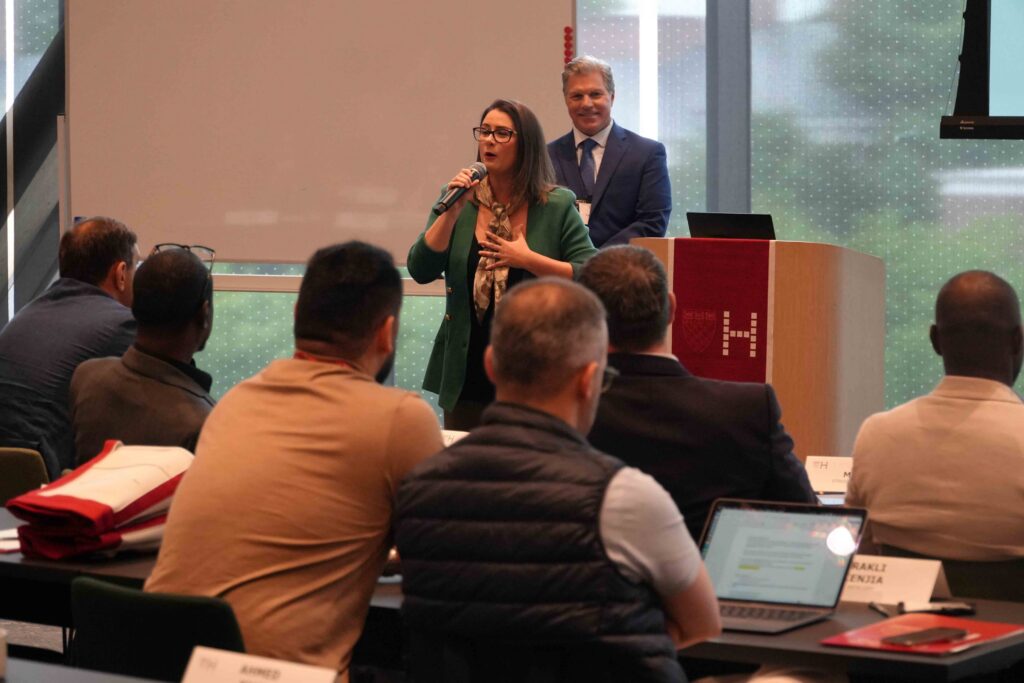
Gallo’s reasoning for challenging Egan draws on the same thing he looks for in the executives and CEOs he studies. “Nowadays everybody wants to sound the same, and AI makes that worse,” he says. “AI can generate words, but it doesn’t have a unique, lived story only you can tell. That’s why I’m always curious about who someone actually is. It’s why I bring up Nvidia CEO Jensen Huang, who often tells the story of working as a busboy at Denny’s. What does that have to do with AI chips and a $5 trillion-dollar company? On its face, nothing. But according to Huang, it’s everything because his early experiences taught him the values that would serve him well as an entrepreneur. People do business with people they trust, and they trust others who share relatable experiences.”
Egan calls this conversation one of the more important lessons of her time in the AMDP, because it changed how she saw her unique personal strengths. That shift was happening in real time, while she was in the middle of redeveloping the public realm at Rockefeller Center.
Gelling: Sustaining the Story After the Deal Is Done
The Urban Land Institute describes real estate development as an eight-stage process, from the first spark of an idea through years of ongoing asset management. At a basic level, what’s happening at each of those stages is the same: someone is being asked to trust a story that hasn’t yet fully proven itself.
The story has to survive contact with the realities of development, from the site to the zoning to the economics. Then it must convince the people who control the money and the permits. When the time comes to actually build the project, it needs to hold together for the teams physically building it. Once the doors open, the story gets handed off to the tenants, residents, and communities who will live in the story and keep shaping it.
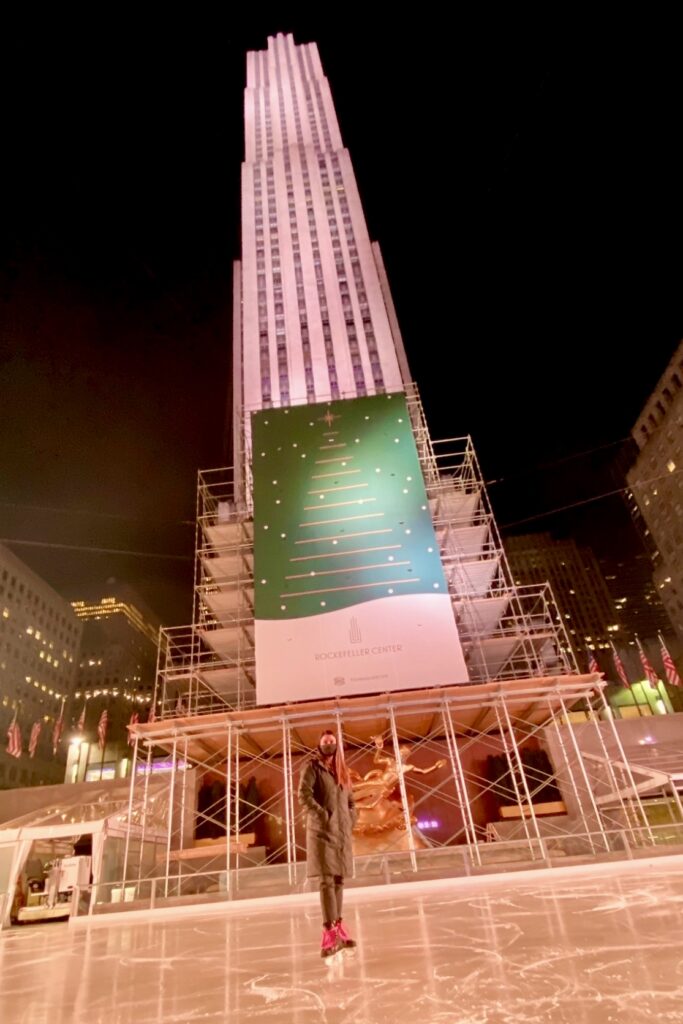
That final, most difficult phase is one Kristin Egan knows well. She completed the AMDP in Class 20 and now serves as an Independent Project Advisor and instructor, working directly with current participants. Her own real estate career took her from developing the largest ice sports center in the Southern Hemisphere to leading the redevelopment of the public realm at Rockefeller Center. That project placed her, quite literally, in the middle of one of the most storied and closely watched public spaces in the country, during a global pandemic.

Stewards, Not Owners
“When you’re working on a landmark like Rockefeller Center, you can’t approach it as an owner,” Egan says. “You have to approach it as a steward. There’s a civic duty in all real estate development, but it’s hugely amplified when you’re working on an iconic place.”
The people she needed to convince weren’t investors or regulators. They were the people who already loved the place — some of them for fifty years.
“There was a group of about two hundred people who had been ice skating at Rockefeller Center for decades,” Egan says. “It’s their identity. When we took over, they didn’t know us, and their guard was immediately up.”


Her first instinct, she admits, was to treat those relationships as a lower priority. “Your instinct is to say you don’t have time,” Egan says. “Your calendar is packed. There are so many people who have a connection to that place — a connection that predates and outlasts anything you’re doing there. Tenants, employees of tenants, people who’d been skating at the rink for fifty years. You look at your schedule and think, I can’t possibly give this the time it seems to want.”
She made the time anyway, meeting with a handful of the group’s members directly — and it changed the outcome of the entire project.
“Once I prioritized meeting with them, I was able to get their buy-in on our vision,” she says. “And then they sold it to everyone else for me. You don’t have to tell the story yourself. You give people your time, earn their trust, and they’ll tell it for you.”
It’s a distinction Egan describes almost as a shift in authorship. The story of a place, she says, doesn’t have to originate entirely with the developer. In fact, the community can become a co-author of it, if given the chance.
“You don’t start listening to a community when you walk into the landmarks preservation meeting,” Egan says. “By then, you’re already behind. You have to listen early and let their perspective shape the story. It’s actually less work — you’re not creating something from scratch. You’re tapping into energy that already exists.”
Authority, Value, and Vulnerability
A real estate developer who expandeed into the media industry, Egan has spent recent years studying, almost obsessively, what actually earns trust.
She points to Ray Dalio’s Principles as a useful test case. The book is split cleanly into two halves: a personal memoir, and a set of hard-won lessons from Dalio’s career. “Without the first part, Ray Dalio is just kind of a jerk,” Egan says. “It’s the story of how he got there that makes the principles worth trusting.”
That distinction, she says, points to something most professionals get wrong when they try to build credibility. “There’s only one goal of thought leadership, one goal, and that’s to build trust,” Egan says. “With trust, everything is possible. Without it, nothing is.”
Her trust-building framework has three parts. The first is authority — providing proof, not just claims, that you know what you’re talking about. “You don’t tell people you have twenty years of experience,” Egan says. “You show them outcomes.” The second is value: something the audience can actually act on, not just admire. And the third, the piece most people leave out entirely, is vulnerability — a real story of failure or transformation, not just competence.
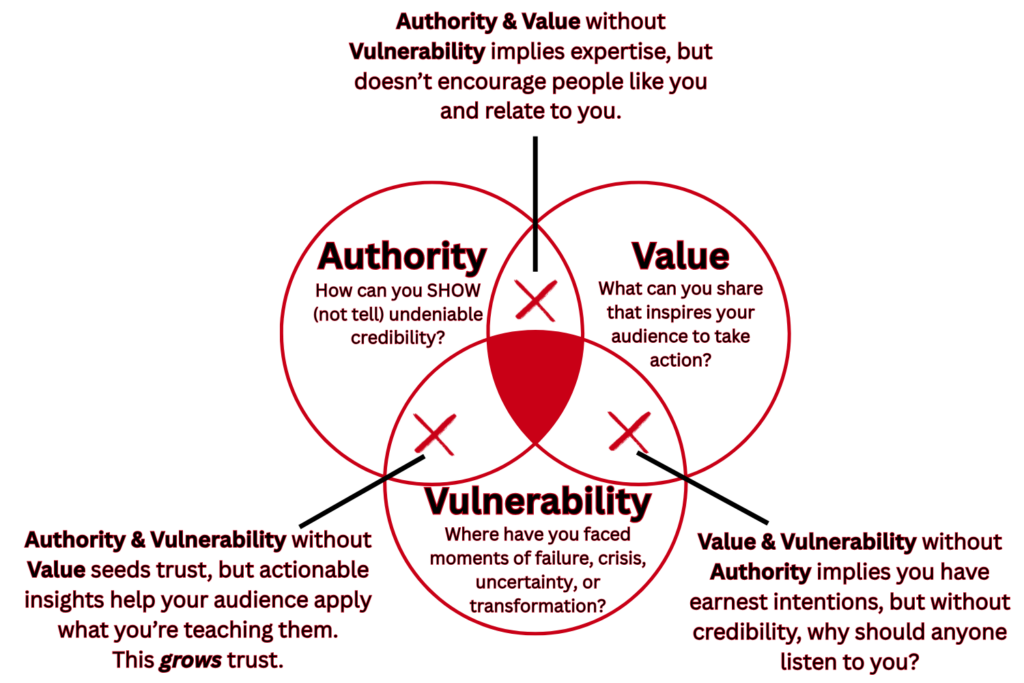
“If you have authority and value but no vulnerability, people know you’re competent, but they don’t relate to you,” Egan says.
These three ingredients, she argues, apply just as much to a real estate project as to a personal brand. A pitch built entirely on financial authority, with no story of vulnerability or shared value, rarely earns the kind of trust that survives past the closing table.
What A Focus on Numbers Misses
Real estate has no shortage of ways to quantify success, from IRRs to cap rates, absorption schedules, and more. Stories and stakeholder perspectives don’t always fit neatly into decision processes.
At Rockefeller Center, listening to the community surfaced complaints that would never have shown up otherwise—small frustrations the previous stewards had never addressed.
“There were changes they wanted, improvements that they thought were necessary,” Egan says. “A lot of it was stuff that, with the kind of capital we had, we could actually do — but we wouldn’t have known to do it if we didn’t know it was a complaint of theirs. Fixing one tiny little thing, or adjusting the design in a small way, had such a huge impact.”


That impact would not have been possible with a strictly quantitative approach. “The most important part of storytelling, in that context, is listening,” Egan says. “Not everything that matters can be measured.
Storytelling Helps Build Places People Love
Story Building: Secrets of Narrative Placemaking and Design from Entertainment Architecture, Steve Tatham’s program, born out of his own time as an AMDP participant, is built around exactly the progression laid out here: finding the emotional core of a project (Telling), pitching it with vision rather than facts alone (Selling), and sustaining that story for years after the deal closes (Gelling).
Story Building: Secrets of Narrative Placemaking and Design from Entertainment Architecture
December 9, 11, & 14, 2026 | Online
11:00am – 01:00pm Eastern
As Carmine Gallo is fond of saying, anyone can be a storyteller. And even though most real estate executives don’t think of themselves that way, the ones who embrace the idea and commit to growing their skills as storytellers are the ones building places people actually come to love.
P.S. A Closing Note on the AMDP
They don’t seem like they have much in common at first:
- A former Disney and Universal creative director.
- A communications advisor to some of the world’s best-known executives.
- A real estate developer who left the industry to build a media company.
But look closely, and all three are connected by more than a shared belief in storytelling. They’re connected by the same program: the AMDP.
Carmine Gallo has spent years teaching for the AMDP, working directly with participants as they learn to pitch their own projects. Kristin Egan experienced the program first hand as a member of Class 20, and now advises the participants who are where she once was. Steve Tatham’s program exists, in a very literal sense, because of an observation he made as an AMDP participant — that brilliant developers, with brilliant projects, were routinely failing to tell their stories effectively.
The AMDP is actively building its next cohort of eclectic thinkers, ideal for individuals who are eager to shape the built environment and the program’s future. Please reach out with questions.
Advanced Management Development Program in Real Estate (AMDP)
July 2027 – July 2028 | On Campus
Class 27 (returning) and Class 28 (new)